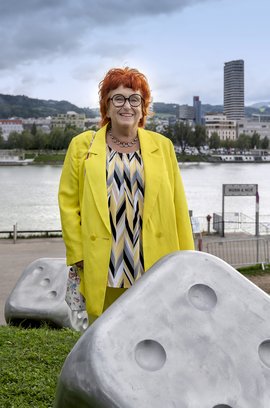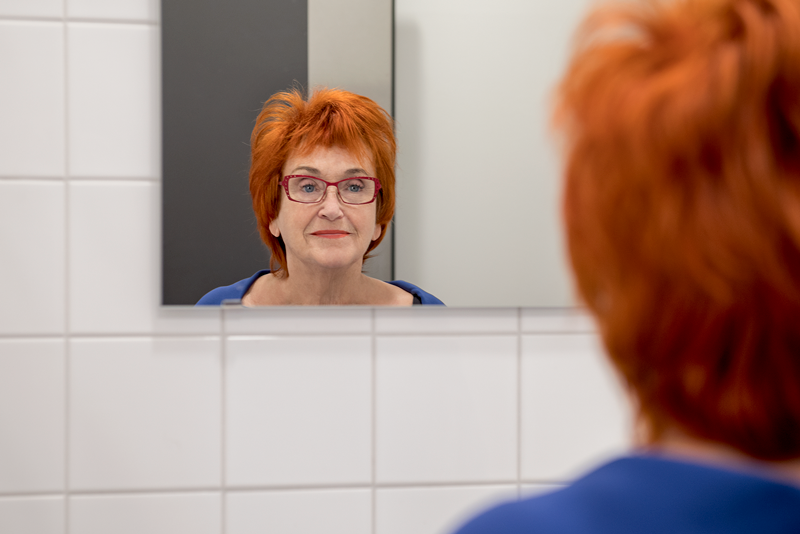
VALIE EXPORT (1940 – 2026)
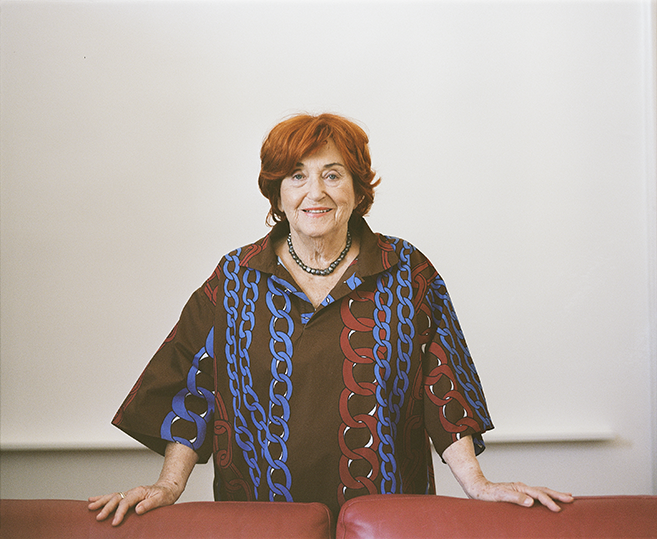
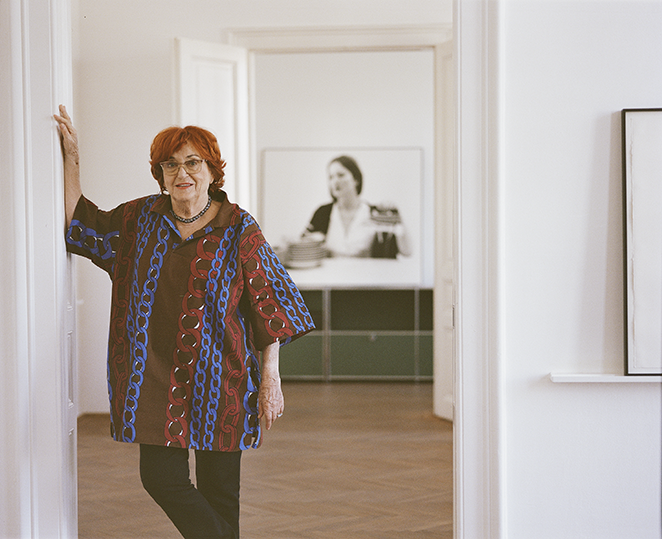
We mourn the loss of VALIE EXPORT. The artist and filmmaker passed away on May 14, 2026, in Vienna.
In 1967, the Linz-born artist chose a new name and liberated herself from imposed structures. She was very aware of the entanglements of power and identity. She made a clean break: VALIE EXPORT—the recognizable brand of her public artistic persona and the program of her conceptual aesthetic production.
“Valie was, so to speak, my nickname. I chose EXPORT because I wanted to transmit my ideas and thoughts, and also because it’s easy to remember. Once it became clear to me that EXPORT was my artist’s name, I looked around for an object that would clearly visualize my artist’s name. That’s how I came across the package of the Smart Export cigarette brand, which a lot of people smoked back then. I thought to myself, that’s really the obvious choice” (VALIE EXPORT 2007).
VALIE EXPORT rejected the attributions imposed by so-called authorities in order to become the author of her own work. She associated this emancipatory gesture with the cigarette soft pack simply because it’s handy. She cut it up and glued it together again with her portrait and her name: VALIE EXPORT, semper et ubique, Made in Austria. The photograph VALIE EXPORT – SMART EXPORTSelf-Portrait (1970), created in collaboration with Gertraud Wolfschwenger, is a celebration of this casual act.
From 1960 onward VALIE EXPORT lived in Vienna. She trained as a textile designer and continued to work with whatever was at hand: with her contemporaries, who at that time were continually reinventing and interconnecting language art, forms of protest, actions, and film. With the body, with the voice, with writing, with pain, with stones, with seaweed, with bread, with knives, with glass, with wires, with batteries, with blood, with milk, with gasoline, with ladders, with trains, with cameras, with monitors, with the typewriter, with the apartment, with the city, and with the beach.
From the late 1960s onward, she transported her ideas and thoughts—her material actions, performances, films, and expanded cinema works—into the world. The avant-garde film scene in Vienna was aesthetically innovative and connected via personal friendships. In 1968, Ernst Schmidt Jr., Hans Scheugl, Kurt Kren, Peter Weibel, VALIE EXPORT, and Gottfried Schlemmer founded the Austria Filmmakers Cooperative. Modeled on existing cooperatives in New York, London, Amsterdam, and Hamburg, the Vienna organization sought to promote independent film productions. The goal was to establish their own distribution networks to increase the reach and visibility of aesthetically sophisticated films. VALIE EXPORT’s works were exhibited, discussed, and received numerous awards within the international networks of underground cinema and feminist film. Her films and video works have been featured at festivals in Knokke, London, Cologne, Paris, Amsterdam, San Francisco, New York, Los Angeles, Cannes, Locarno, Hong Kong, Berlin, Sydney, Vancouver, and Montreal, among others..
In the late 1960s, the performance pieces and photographic works were also created in which the spirit of the times—characterized by revolt—was condensed into visual, iconic, and linguistic forms. In the titles of her works, VALIE EXPORT established her own art of compound words: TAPP und TASTKINO (Tap and Touch Cinema) (1968), Aktionshose: Genitalpanik (Action Pants: Genital Panic) (1969). As with a split screen or a single-frame montage in film, it is about the abrupt leap from material to meaning, from affect to subversion. VALIE EXPORT’s work titles often have elements of staged physicality.
The oppressive codes of social behavior and patriarchal force that subjugates women’s bodies are recurring subjects of VALIE EXPORT’s photographic and cinematic visual explorations. Among her best-known series are the Körperkonfigurationen (Body Configurations, 1972–1982). Lying, crouching, leaning, stretching, a woman in the black-and-white photographs attempts to integrate her body into overpowering, grand-scale architectural structures—and yet cannot find a place. In the films Unsichtbare Gegner (Invisible Adversary, 1977) and Syntagma (1984), in which Vienna’s public spaces serve as the setting, the protagonists remain exposed to a threatening, alienating exterior. In Syntagma, VALIE EXPORT works with split screens, reflections, image projections within the cinematic space, and a destabilizing multiplication of perceptual perspectives. The film’s protagonist experiences herself as split in a world where images multiply and intertwine endlessly. Her perceptions and actions seem structured by her visible existence in the world: by the images of herself that confront her from outside herself.
As a visual artist, VALIE EXPORT has taken up traditional genres and expanded them through process-oriented methods and new technologies. The diverse practices, media, and cultural locations of her work are impressive: drawings, conceptual photographs, films, actions, performances, performance-based videos, screenplays, installations, sculptures in public spaces, television documentaries, a CD-ROM that serves as a navigable catalog raisonné, manifestos, poems, and texts on feminism and contemporary art.
Museums and exhibition venues such as the Centre Pompidou in Paris, the Israel Museum in Jerusalem, the Belvedere Museum in Vienna, the Kunsthaus Bregenz, the Lentos Art Museum in Linz, the Neue Berliner Kunstverein, the Pavillon Populaire in Montpellier, the MARe in Bucharest, the Staatliche Kunsthalle in Baden-Baden, the Fotomuseum in Winterthur, the Albertina in Vienna, and C/O Berlin have all dedicated solo exhibitions to VALIE EXPORT. In 1980, Maria Lassnig and VALIE EXPORT were the first female artists to represent Austria at the Venice Biennale (in the Austrian Pavilion). VALIE EXPORT participated in Documenta 6 (1977) and Documenta 12 (2007).
VALIE EXPORT’s outstanding achievements in the visual arts were honored in 2019 with the Roswitha Haftmann Prize (Switzerland). In 2022, VALIE EXPORT received the Max Beckmann Prize from the City of Frankfurt am Main (Germany) and the Grand Decoration of Honour in Silver with Star for Services to the Republic of Austria.
IFor VALIE EXPORT, transmission of her ideas and thoughts also means raising the profile of women’s artistic work. She has curated feminist symposia and groundbreaking exhibitions such as MAGNA: Feminismus: Kunst und Kreativität (MAGNA: Feminism: Art and Creativity, 1975) and Kunst mit Eigen-Sinn: Aktuelle Kunst von Frauen (Art with a Mind of Its Own: Contemporary Art by Women, 1985, together with Silvia Eiblmayr, Cathrin Pichler, and Monika Prischl-Maier). Also with Silvia Eiblmayr, VALIE EXPORT served as curator for the Austrian Pavilion at the 2009 Venice Biennale.
Like in her work as a curator, VALIE EXPORT also seeks, as an artist, author, and educator, to impart diverse visual experiences and analytical insights. In a text published in Kunstforum International in 1977, VALIE EXPORT explained that the then-new art form of performance offered the audience the opportunity to talk and discuss with the artists afterward. “Performance is a relatively young form of expression, and people first have to get to know it” (VALIE EXPORT 1977). In her text, she envisions a future with greater visibility for performance art and greater openness on the part of the audience. VALIE EXPORT assumes that an audience more familiar with performances would also be enabled to draw its own conclusions and make aesthetic judgments.
Art can be understood as communication and social interaction with the audience, for example, in performance art or expanded cinema. Moreover, art can also become both the occasion for and the subject of communication. In VALIE EXPORT’s case, this includes international lectures, discussions, manifestos, conceptual texts, and art criticism essays. Beginning in the 1980s, VALIE EXPORT taught at art colleges and universities in Austria, Germany, and the United States. Her long tenure as a professor of film at the University of Wisconsin, Milwaukee (1983–1991) brought VALIE EXPORT into contact with English-language feminist film and media theory. Appointments to professorships at the Berlin University of the Arts (1991–1995) and the Academy of Media Arts Cologne (1995–2005) followed. In addition to her academic teaching, VALIE EXPORT pursued educational projects with a greater outreach in the 1980s and 1990s. For ORF, Austria’s national public broadcaster, she developed art education documentaries. Intensive research processes, dense montages of material, theoretically sophisticated explanations, and visual effects transformed her television works into avant-garde educational experiments. The buzzwords “science communication” or the “Third Mission (of the university)” would not come into circulation until many years later.
To put across her ideas and thoughts, VALIE EXPORT acquired comprehensive conceptual and practical knowledge of media technology. She combined curiosity about formal experimentation with a critical perspective on the technological restructuring of perception, knowledge, time, reach, and social interaction. As a “Visionary Pioneer of Feminist Media Art,” VALIE EXPORT was awarded the Prix Ars Electronica 2020 for her feminist, forward-looking media art. In 1999, at a time when modems were dialing into the telephone network with a loud beep, VALIE EXPORT wrote about the Internet as a “control mechanism” (VALIE EXPORT 1999). She introduced the concept of a “data shadow”: this uncanny doppelgänger, beyond our control, is spawned by our navigation of the Web: “In daily life, we leave behind an ever-growing abundance of electronic traces” (VALIE EXPORT 1999).
VALIE EXPORT’s digital traces, data storage media, and documents related to her working processes truly constitute a carefully preserved treasure trove! Since the 1960s, she built up an extensive archive of her artistic and curatorial projects. In 2015, the City of Linz acquired the archive and transferred it to the collection of the Lentos Art Museum. Since November 2017, her personal library and the extensive archival holdings have been accessible to researchers and interested parties at the VALIE EXPORT Center—Research Center for Media and Performance Art. The archive offers a great deal to learn about the precarious conditions of artistic work, about creative processes, about sexist hostility, about the influence of feminist networks, about well-founded hopes, about failed projects, about historical upheavals, and about the forces of social resistance.
We are deeply saddened by the death of VALIE EXPORT. We remember her with great admiration and gratitude. We have learned so much from her artistic works, her feminist stance, and her critical research on the present day. An irresolvable contradiction will always remain for us: between the provocative radicalism of VALIE EXPORT’s work and the heartwarming, humorous encounters with VALIE.
We are only very slowly coming to terms with the fact that we must now work toward utopias without her—against lethargy, against conformism, and against power and violence.
Linz, May 18, 2026